Guide · podcast outreach
How to invite someone onto a business podcast
By George Lowe · Founder, PodReach · PodReach
Published 24 July 2026 · Updated 24 July 2026
A credible business-podcast invitation names a specific reason the guest is a fit, offers a conversation valuable on its own, reduces scheduling friction, and follows up respectfully — without treating the interview as a disguised sales trap.
A business-podcast invitation is a personal request for someone to join a recorded conversation that will be published. Unlike a cold sales request, the first conversion is a conversation, not a demo.
This guide covers guest selection, research, invitation writing, LinkedIn versus email, follow-up timing, booking handoff, common mistakes and ethical boundaries. Use it whether you operate in spreadsheets or a podcast relationship platform.
Select guests who belong on the show
Start with fit, not volume. A guest is suitable when they can speak usefully about a topic your audience cares about, and when a public conversation is a natural way to start or deepen a professional relationship.
- They have lived experience your listeners want to hear
- You can explain why this show — not any show — is relevant to them
- You would still publish the episode if no commercial opportunity followed
- You are prepared to respect a “no” or “not now” without pressure
Research before you write
Personalisation that only inserts a first name is not research. Capture a few notes that change the invitation: recent work, a talk, a post, a product launch, or a tension in their market you want to explore.
- Role context — What they do and who they serve
- Proof of relevance — One specific artefact (post, talk, product, essay)
- Audience overlap — Why your listeners care about their perspective
- Episode angle — The conversation topic in one sentence
- Risk reducers — Format, length, prep load, and publishing intent
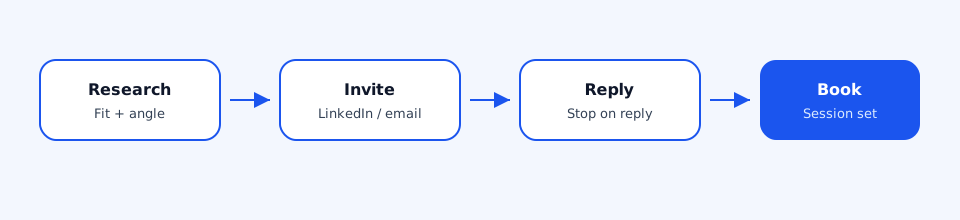
Write an invitation that reduces perceived risk
Busy guests scan for three things: who you are, why them, and what you are asking them to give. Lead with relevance, state the format clearly, and make the next step easy.
- Context — Who you are and what the show is about in one line
- Specific relevance — The artefact or angle that made you invite them
- Guest outcome — What they get: thoughtful conversation, published episode, shareable clips if you produce them
- Ask — Clear request: a recorded conversation of a stated length
- Friction reducers — Prep expectations, scheduling method, and an easy decline path
Hi {{Name}} — I host {{Show}}, where we talk with operators about {{theme}}. Your {{specific work}} stood out because {{reason}}. I’d like to invite you for a {{length}} conversation on {{angle}}. We publish the episode and can share assets afterward. If useful, here’s a booking link / two time windows. If timing is off, no worries — happy to reconnect later.LinkedIn versus email
Choose the channel where you can be personal and where the guest is likely to see a professional request. Many hosts start on LinkedIn when that is the guest’s public professional surface, and use email when they have a direct address or a warm introduction path.
| Signal | Lean LinkedIn | Lean email |
|---|---|---|
| Relationship stage | Cold or light prior interaction | Warm intro or known work address |
| Message length | Short, scannable | Slightly more context and logistics |
| Risk | Connection limits / platform norms | Deliverability and list quality |
| Follow-up | Sparse, human | Scheduled but stop when they reply |
Whatever channel you use, follow that platform’s rules and the guest’s preferences. PodReach supports LinkedIn and email invitation workflows when those accounts are connected for a workspace; it does not invent unsupported sending channels.
Follow-up timing without pressure
One thoughtful follow-up often helps because inboxes are crowded. A sequence that ignores replies or declines damages trust. Prefer stop-on-reply behaviour and human judgment after engagement.
- Wait long enough for a real chance to reply (often a few business days)
- Restate the angle briefly — do not escalate into a pitch
- Offer an easy out (“If now is not right, all good”)
- Stop automated follow-up when they respond
Hand off accepted invitations into booking
When someone says yes, move quickly to logistics: time, format, prep expectations, and recording link. Lost handoffs are a common operational failure — the relationship warmth decays while the host “means to schedule.”
In PodReach, outreach can connect into booking and session planning so accepted guests do not live only in a thread. If you are not using a platform, at least keep a shared pipeline stage for “accepted → booked.”
Common mistakes
- Inviting people who cannot credibly be guests for your show
- Leading with your product instead of the conversation
- Sending identical blasts with no specific angle
- Continuing sequences after a clear decline
- Faking a podcast that will never be published
- Pitching mid-interview without consent
Ethical boundaries
Podcast-led outreach only works when the show is real. Do not use “come on my podcast” as bait for a sales call you never intend to publish. Do not misrepresent audience size, format, or commercial intent.
For channel compliance, follow the rules of the platforms you use. LinkedIn’s professional community policies and email anti-spam expectations apply to invitation outreach the same way they apply to other professional messaging.
When this approach fits
Good fit
- You run or are launching a real business podcast with publishing intent
- Your ideal guests can speak usefully on record
- You can invest in research and personal messaging
Not ideal
- You want high-volume cold demos with no content commitment
- You plan to invent a podcast solely to book sales conversations
- Your ICP cannot reasonably appear as guests
FAQ
How long should a podcast invitation be?
Short enough to scan on a phone: who you are, why them specifically, what you are asking, and how to say yes or no. Extra logistics can wait until they engage.
Should I invite on LinkedIn or email first?
Use the channel where a professional request is most natural for that person. Many hosts start on LinkedIn for public professionals and use email when they have a direct address or warm introduction.
How many times should I follow up?
Often one thoughtful follow-up is enough. Stop when they reply or decline. More volume rarely fixes a weak angle.
Does PodReach send invitations automatically without review?
PodReach is built for campaign drafting and review boundaries so teams can check tone before scale. Relationship-first outreach still requires human judgment.
References
- LinkedIn Professional Community Policies — LinkedIn
- CAN-SPAM Act: A Compliance Guide for Business — U.S. Federal Trade Commission
Related guides
Run invitations inside a relationship workflow
If you want research, LinkedIn and email outreach, stop-on-reply follow-up and booking handoff in one place, explore PodReach — or keep using this framework in your own stack.